Excel · C# walkthrough
Budget scenario comparison
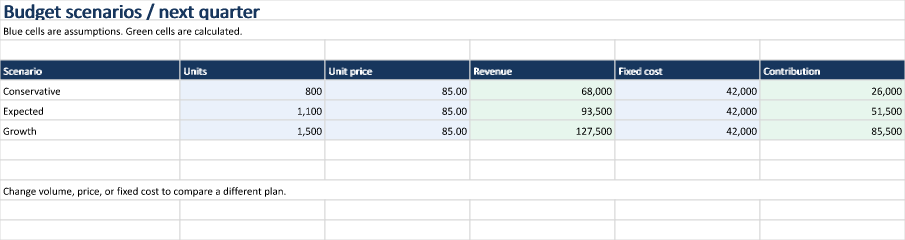
Compare conservative, expected, and growth plans in one worksheet. The example distinguishes editable assumptions from calculated contribution and keeps the formulas inside the workbook.
- Start with
- Volume, unit price, and fixed-cost assumptions
- Generate
- XLSX
How it works
Lay out the assumptions
Write volume, unit price, and fixed cost as numeric cells. Use number formats to control display without turning numbers into strings.
Calculate contribution
Calculate revenue from volume and price, then contribution from revenue and fixed cost. Call Calculate before rendering so both steps have cached values.
Make the inputs visible
Use blue fills for assumptions and green for results. Export the range before Save closes the workbook package.
The C# source
This is the complete example file used to generate the download. The walkthrough runner creates the output directory and produces the additional previews.
using System.IO;
using OfficeIMO.Drawing;
using OfficeIMO.Excel;

namespace OfficeIMO.Examples.Showcase.Workflows;

/// <summary>Compares three budget scenarios using calculated cells and editable assumptions.</summary>
internal static class BudgetScenarios {
    internal static void Create(string folder) {
        using ExcelDocument document = ExcelDocument.Create(Path.Combine(folder, "example.xlsx"));
        ExcelSheet sheet = document.AddWorksheet("Scenarios");
        sheet.MergeRange("A1:F1");
        sheet.Cell(1, 1, "Budget scenarios / next quarter");
        sheet.CellFontSize(1, 1, 20);
        sheet.CellBold(1, 1, true);
        sheet.CellFontColor(1, 1, "17365D");
        sheet.MergeRange("A2:F2");
        sheet.Cell(2, 1, "Blue cells are assumptions. Green cells are calculated.");

        string[] headings = { "Scenario", "Units", "Unit price", "Revenue", "Fixed cost", "Contribution" };
        for (int column = 0; column < headings.Length; column++) {
            sheet.Cell(4, column + 1, headings[column]);
            sheet.CellBackground(4, column + 1, "17365D");
            sheet.CellFontColor(4, column + 1, "FFFFFF");
            sheet.CellBold(4, column + 1, true);
            sheet.SetColumnWidth(column + 1, column == 0 ? 25 : 20);
        }
        string[] labels = { "Conservative", "Expected", "Growth" };
        for (int index = 0; index < labels.Length; index++) {
            int row = index + 5;
            sheet.Cell(row, 1, labels[index]);
            sheet.Cell(row, 2, new[] { 800, 1100, 1500 }[index], numberFormat: "#,##0");
            sheet.Cell(row, 3, 85, numberFormat: "#,##0.00");
            sheet.CellFormula(row, 4, $"B{row}*C{row}");
            sheet.Cell(row, 5, 42000, numberFormat: "#,##0");
            sheet.CellFormula(row, 6, $"D{row}-E{row}");
            sheet.FormatCell(row, 4, "#,##0");
            sheet.FormatCell(row, 6, "#,##0");
            foreach (int column in new[] { 2, 3, 5 }) sheet.CellBackground(row, column, "EAF1FB");
            foreach (int column in new[] { 4, 6 }) sheet.CellBackground(row, column, "E7F6ED");
        }
        sheet.MergeRange("A10:F10");
        sheet.Cell(10, 1, "Change volume, price, or fixed cost to compare a different plan.");
        document.Calculate();
        sheet.Range("A1:F12").ExportImage(OfficeImageExportFormat.Png)
            .Save(Path.Combine(folder, "preview.png"), OfficeImageExportFileConflictPolicy.Replace);
        document.Save();
    }
}
Run it from the source checkout
Clone the OfficeIMO repository and run this command from its root with the .NET 10 SDK. The first run restores the example project's dependencies.
dotnet run --project OfficeIMO.Examples -f net10.0 -- --showcase-workflows --showcase-example excel-budget-scenariosThe files are written to OfficeIMO.Examples/bin/Debug/net10.0/Documents/Workflows/excel-budget-scenarios/. To use the example in your application, start with the Excel guide and its package setup.
Downloads and scope
What the preview shows
The linked C# example generates this file. The runner reopens and validates the XLSX. The image is a native rendering of the specified worksheet range.
What to keep in mind
Contribution here is units multiplied by price minus fixed cost. Variable costs, tax, and cash timing are outside this small model. The calculation is split into cells supported by the native formula engine; more complex expressions may need a spreadsheet application.