Excel · C# walkthrough
Pricing with named ranges
Make a small pricing calculation understandable to the next person who edits it. Named ranges give the formula meaningful terms and make the assumptions visible in the worksheet.
- Start with
- Quantity, unit price, and discount rate
- Generate
- XLSX
How it works
Name the inputs
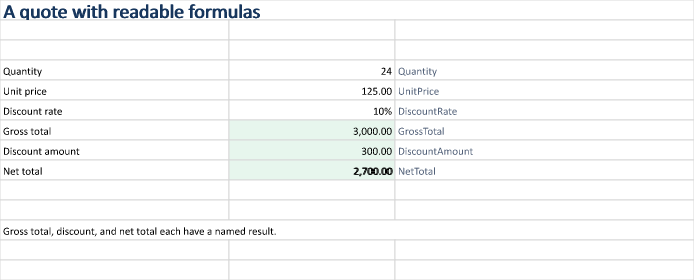
Create workbook-scoped ranges for Quantity, UnitPrice, and DiscountRate, each pointing at its input cell.
Write a readable formula
Use named formulas for gross total, discount amount, and net total. Each step has its own cell so a reader can inspect the calculation.
Format and inspect the result
Evaluate the formula, apply numeric and percentage formats, and render the quote. The sample net total is 2,700.
The C# source
This is the complete example file used to generate the download. The walkthrough runner creates the output directory and produces the additional previews.
using System.IO;
using OfficeIMO.Drawing;
using OfficeIMO.Excel;

namespace OfficeIMO.Examples.Showcase.Workflows;

/// <summary>Uses named ranges to keep a small pricing model readable as the sheet evolves.</summary>
internal static class NamedRangePricing {
    internal static void Create(string folder) {
        using ExcelDocument document = ExcelDocument.Create(Path.Combine(folder, "example.xlsx"));
        ExcelSheet sheet = document.AddWorksheet("Quote");
        sheet.SetColumnWidth(1, 32);
        sheet.SetColumnWidth(2, 23);
        sheet.SetColumnWidth(3, 42);
        sheet.MergeRange("A1:C1");
        sheet.Cell(1, 1, "A quote with readable formulas");
        sheet.CellFontSize(1, 1, 20);
        sheet.CellBold(1, 1, true);
        sheet.CellFontColor(1, 1, "17365D");

        string[] labels = { "Quantity", "Unit price", "Discount rate", "Gross total", "Discount amount", "Net total" };
        string[] names = { "Quantity", "UnitPrice", "DiscountRate", "GrossTotal", "DiscountAmount", "NetTotal" };
        for (int index = 0; index < labels.Length; index++) {
            int row = index + 4;
            sheet.Cell(row, 1, labels[index]);
            sheet.Cell(row, 3, names[index]);
            sheet.CellFontColor(row, 3, "526179");
            document.SetNamedRange(names[index], $"'Quote'!B{row}", save: false);
        }
        sheet.Cell(4, 2, 24, numberFormat: "#,##0");
        sheet.Cell(5, 2, 125, numberFormat: "#,##0.00");
        sheet.Cell(6, 2, 0.10, numberFormat: "0%");
        sheet.CellFormula(7, 2, "Quantity*UnitPrice");
        sheet.CellFormula(8, 2, "GrossTotal*DiscountRate");
        sheet.CellFormula(9, 2, "GrossTotal-DiscountAmount");
        for (int row = 7; row <= 9; row++) {
            sheet.FormatCell(row, 2, "#,##0.00");
            sheet.CellBackground(row, 2, "E7F6ED");
        }
        sheet.CellBold(9, 2, true);
        sheet.MergeRange("A12:C12");
        sheet.Cell(12, 1, "Gross total, discount, and net total each have a named result.");
        document.Calculate();
        sheet.Range("A1:C14").ExportImage(OfficeImageExportFormat.Png)
            .Save(Path.Combine(folder, "preview.png"), OfficeImageExportFileConflictPolicy.Replace);
        document.Save();
    }
}
Run it from the source checkout
Clone the OfficeIMO repository and run this command from its root with the .NET 10 SDK. The first run restores the example project's dependencies.
dotnet run --project OfficeIMO.Examples -f net10.0 -- --showcase-workflows --showcase-example excel-named-range-pricingThe files are written to OfficeIMO.Examples/bin/Debug/net10.0/Documents/Workflows/excel-named-range-pricing/. To use the example in your application, start with the Excel guide and its package setup.
Downloads and scope
What the preview shows
The linked C# example generates this file. The runner reopens and validates the XLSX. The image is a native rendering of the specified worksheet range.
What to keep in mind
The sample demonstrates one workbook-level calculation. It does not implement a pricing policy, tax engine, or negotiated-price approval process. Each calculation step uses the native formula engine supported by this example.