Excel · C# walkthrough
Training coverage matrix
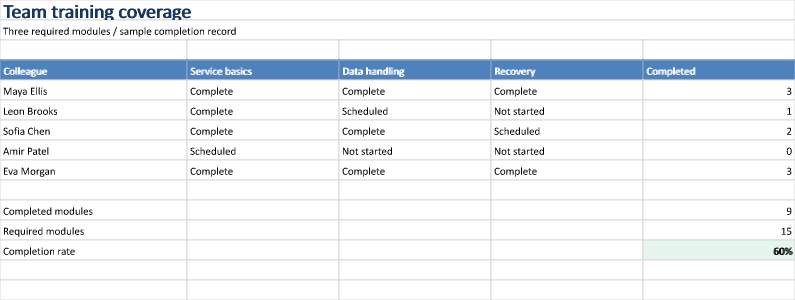
See who has completed the required modules and where follow-up is needed without maintaining a separate summary by hand.
- Start with
- People, required modules and completion states
- Generate
- XLSX
How it works
Build the matrix
Place colleagues in rows and required modules in columns, with a dedicated calculated total.
Constrain the states
Add a validation list with Not started, Scheduled and Complete so entries stay consistent.
Count completion
Use COUNTIF for each person, SUM for the team total and a percentage cell for overall coverage.
The C# source
This is the complete example file used to generate the download. The walkthrough runner creates the output directory and produces the additional previews.
using OfficeIMO.Drawing;
using OfficeIMO.Excel;

namespace OfficeIMO.Examples.Showcase.Workflows;

/// <summary>Combines validated completion states with per-person and team training counts.</summary>
internal static class TrainingMatrix {
    internal static void Create(string folder) {
        using ExcelDocument document = ExcelDocument.Create(Path.Combine(folder, "example.xlsx"));
        var sheet = document.AddWorksheet("Training");
        sheet.SetColumnWidth(1, 26);
        for (int column = 2; column <= 5; column++) sheet.SetColumnWidth(column, 21);
        sheet.MergeRange("A1:E1"); sheet.Cell(1, 1, "Team training coverage");
        sheet.CellFontSize(1, 1, 20); sheet.CellBold(1, 1, true); sheet.CellFontColor(1, 1, "17365D");
        sheet.MergeRange("A2:E2"); sheet.Cell(2, 1, "Three required modules / sample completion record");
        string[,] values = {
            { "Colleague", "Service basics", "Data handling", "Recovery", "Completed" },
            { "Maya Ellis", "Complete", "Complete", "Complete", "" },
            { "Leon Brooks", "Complete", "Scheduled", "Not started", "" },
            { "Sofia Chen", "Complete", "Complete", "Scheduled", "" },
            { "Amir Patel", "Scheduled", "Not started", "Not started", "" },
            { "Eva Morgan", "Complete", "Complete", "Complete", "" }
        };
        for (int row = 0; row < 6; row++) for (int column = 0; column < 5; column++) sheet.Cell(row + 4, column + 1, values[row, column]);
        for (int row = 5; row <= 9; row++) sheet.CellFormula(row, 5, $"COUNTIF(B{row}:D{row},\"Complete\")");
        sheet.AddTable("A4:E9", hasHeader: true, name: "Training", style: ExcelTableStyle.TableStyleMedium2);
        sheet.ValidationList("B5:D9", new[] { "Not started", "Scheduled", "Complete" });
        sheet.Cell(11, 1, "Completed modules"); sheet.CellFormula(11, 5, "SUM(E5:E9)");
        sheet.Cell(12, 1, "Required modules"); sheet.Cell(12, 5, 15);
        sheet.Cell(13, 1, "Completion rate"); sheet.CellFormula(13, 5, "E11/E12"); sheet.FormatCell(13, 5, "0%");
        sheet.CellBackground(13, 5, "E7F6ED"); sheet.CellBold(13, 5, true);
        document.Calculate();
        sheet.Range("A1:E15").ExportImage(OfficeImageExportFormat.Png).Save(Path.Combine(folder, "preview.png"), OfficeImageExportFileConflictPolicy.Replace);
        document.Save();
    }
}
Run it from the source checkout
Clone the OfficeIMO repository and run this command from its root with the .NET 10 SDK. The first run restores the example project's dependencies.
dotnet run --project OfficeIMO.Examples -f net10.0 -- --showcase-workflows --showcase-example excel-training-matrixThe files are written to OfficeIMO.Examples/bin/Debug/net10.0/Documents/Workflows/excel-training-matrix/. To use the example in your application, start with the Excel guide and its package setup.
Downloads and scope
What the preview shows
The linked C# example generates this file. The runner reopens and validates the XLSX and checks supported formulas, cached results and dependencies. The PNG is a native worksheet-range export.
What to keep in mind
The example records completion states, not accredited certification. The preview does not exercise Excel's interactive validation dropdown.