Markdown · C# walkthrough
An API handover guide
Give an integration team a compact guide they can keep with the code. The example brings a request, response, field contract, and handover checklist into one Markdown document.
- Start with
- Request fields, example payloads, and integration notes
- Generate
- MD + PDF
How it works
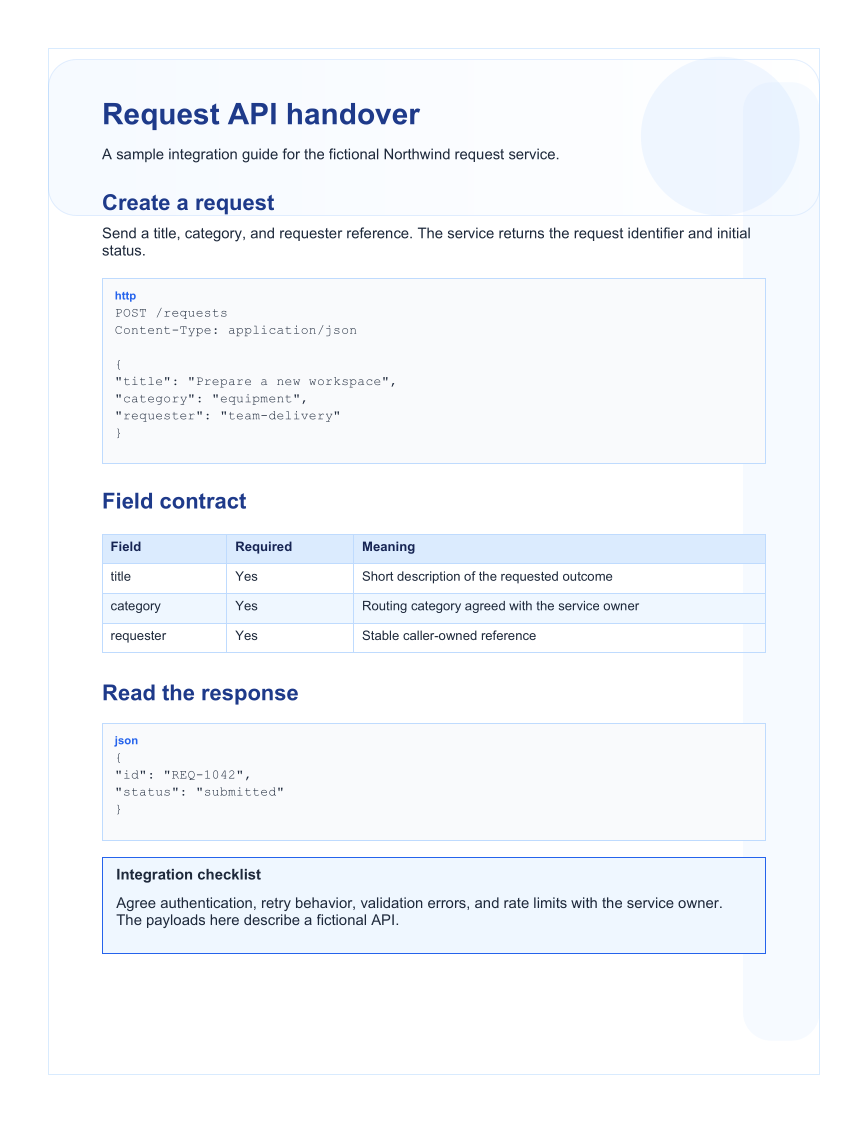
Show a representative request
Use an HTTP code fence to keep the method, path, headers, and body together.
Explain the fields
Build a table for required fields and their meaning, then add a JSON response example.
Name the unresolved integration details
Use a note callout for authentication, retries, validation errors, and limits that must be agreed with the service owner.
The rest of the document
The C# source
This is the complete example file used to generate the download. The walkthrough runner creates the output directory and produces the additional previews.
using System.IO;
using OfficeIMO.Markdown;

namespace OfficeIMO.Examples.Showcase.Workflows;

/// <summary>Generates an API handover guide with request examples and a field contract table.</summary>
internal static class ApiHandover {
    internal static void Create(string folder) {
        MarkdownDoc document = MarkdownDoc.Create()
            .H1("Request API handover")
            .P("A sample integration guide for the fictional Northwind request service.")
            .H2("Create a request")
            .P("Send a title, category, and requester reference. The service returns the request identifier and initial status.")
            .Code("http", "POST /requests\nContent-Type: application/json\n\n{\n  \"title\": \"Prepare a new workspace\",\n  \"category\": \"equipment\",\n  \"requester\": \"team-delivery\"\n}")
            .H2("Field contract")
            .Table(table => table.Headers("Field", "Required", "Meaning")
                .Row("title", "Yes", "Short description of the requested outcome")
                .Row("category", "Yes", "Routing category agreed with the service owner")
                .Row("requester", "Yes", "Stable caller-owned reference"))
            .H2("Read the response")
            .Code("json", "{\n  \"id\": \"REQ-1042\",\n  \"status\": \"submitted\"\n}")
            .Callout("note", "Integration checklist",
                "Agree authentication, retry behavior, validation errors, and rate limits with the service owner. The payloads here describe a fictional API.")
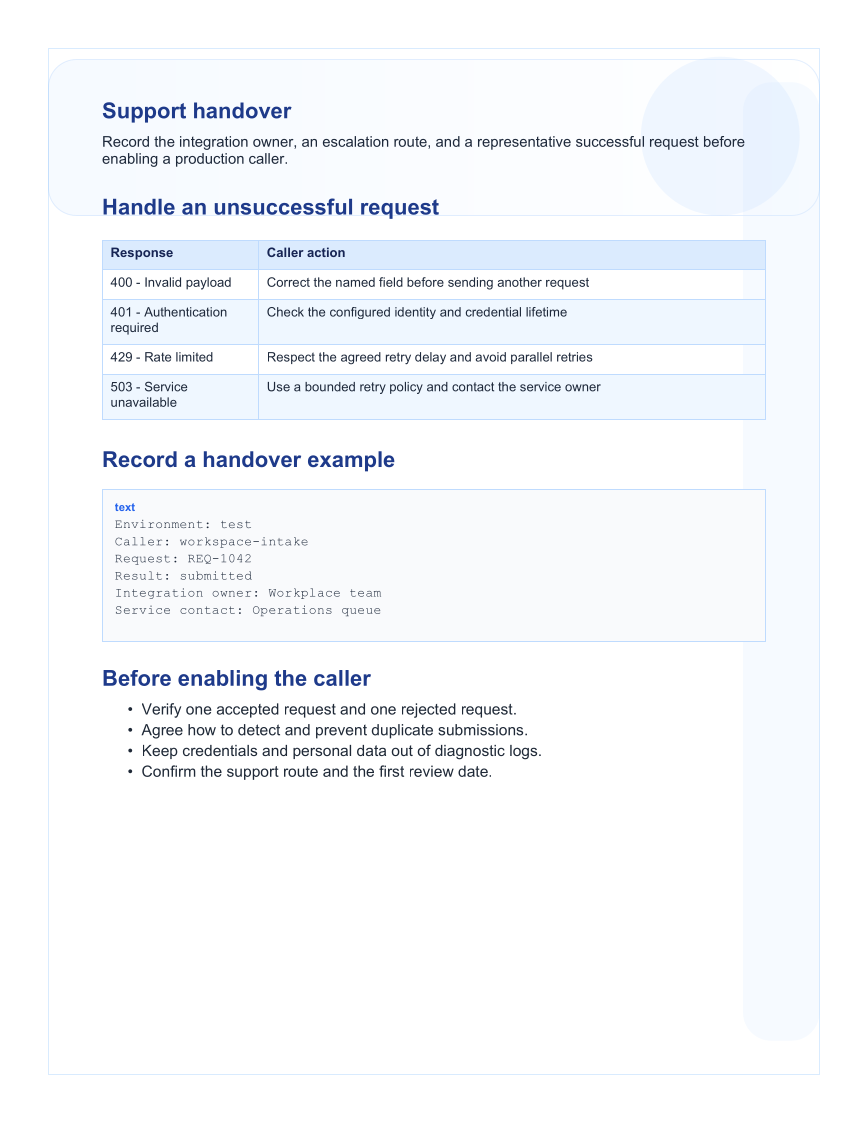
            .H2("Support handover")
            .P("Record the integration owner, an escalation route, and a representative successful request before enabling a production caller.")
            .H2("Handle an unsuccessful request")
            .Table(table => table.Headers("Response", "Caller action")
                .Row("400 - Invalid payload", "Correct the named field before sending another request")
                .Row("401 - Authentication required", "Check the configured identity and credential lifetime")
                .Row("429 - Rate limited", "Respect the agreed retry delay and avoid parallel retries")
                .Row("503 - Service unavailable", "Use a bounded retry policy and contact the service owner"))
            .H2("Record a handover example")
            .Code("text", "Environment: test\nCaller: workspace-intake\nRequest: REQ-1042\nResult: submitted\nIntegration owner: Workplace team\nService contact: Operations queue")
            .H2("Before enabling the caller")
            .Ul(new[] { "Verify one accepted request and one rejected request.",
                "Agree how to detect and prevent duplicate submissions.",
                "Keep credentials and personal data out of diagnostic logs.",
                "Confirm the support route and the first review date." });
        File.WriteAllText(Path.Combine(folder, "example.md"), document.ToMarkdown());
    }
}
Run it from the source checkout
Clone the OfficeIMO repository and run this command from its root with the .NET 10 SDK. The first run restores the example project's dependencies.
dotnet run --project OfficeIMO.Examples -f net10.0 -- --showcase-workflows --showcase-example markdown-api-handoverThe files are written to OfficeIMO.Examples/bin/Debug/net10.0/Documents/Workflows/markdown-api-handover/. To use the example in your application, start with the Markdown guide and its package setup.
Downloads and scope
What the preview shows
The linked C# example generates this file. The Markdown builder creates the source file. The runner exports a PDF, which is rendered for the preview.
What to keep in mind
The Northwind API is fictional. The example generates documentation and does not make network requests or validate an OpenAPI specification.