Markdown · C# walkthrough
A portable incident runbook
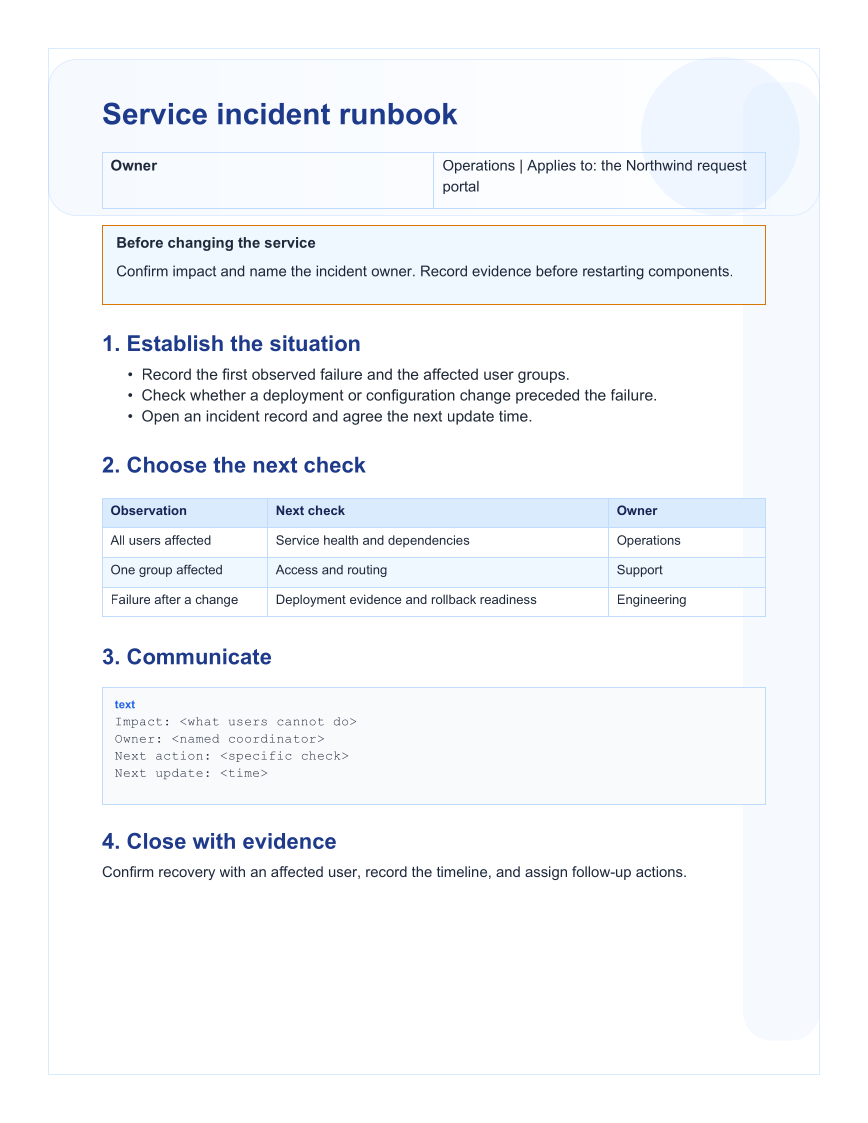
Keep a runbook usable in a repository and as an offline document. The example combines short steps with a decision table and a copyable incident-update template.
- Start with
- Response steps, ownership, and communication guidance
- Generate
- MD + PDF
How it works
Put the precondition first
Add a warning callout that asks the responder to establish impact and ownership before making changes.
Describe the next check
Build a table that maps an observation to a concrete check and its owner.
Provide a reusable update format
Add a fenced text block for impact, owner, next action, and next update, then save the Markdown source.
The C# source
This is the complete example file used to generate the download. The walkthrough runner creates the output directory and produces the additional previews.
using System.IO;
using OfficeIMO.Markdown;

namespace OfficeIMO.Examples.Showcase.Workflows;

/// <summary>Authors a portable incident runbook with structured steps, a decision table, and a warning.</summary>
internal static class IncidentRunbook {
    internal static void Create(string folder) {
        MarkdownDoc document = MarkdownDoc.Create()
            .H1("Service incident runbook")
            .P("Owner: Operations | Applies to: the Northwind request portal")
            .Callout("warning", "Before changing the service",
                "Confirm impact and name the incident owner. Record evidence before restarting components.")
            .H2("1. Establish the situation")
            .Ul(list => list.Item("Record the first observed failure and the affected user groups.")
                .Item("Check whether a deployment or configuration change preceded the failure.")
                .Item("Open an incident record and agree the next update time."))
            .H2("2. Choose the next check")
            .Table(table => table.Headers("Observation", "Next check", "Owner")
                .Row("All users affected", "Service health and dependencies", "Operations")
                .Row("One group affected", "Access and routing", "Support")
                .Row("Failure after a change", "Deployment evidence and rollback readiness", "Engineering"))
            .H2("3. Communicate")
            .Code("text", "Impact: <what users cannot do>\nOwner: <named coordinator>\nNext action: <specific check>\nNext update: <time>")
            .H2("4. Close with evidence")
            .P("Confirm recovery with an affected user, record the timeline, and assign follow-up actions.");
        File.WriteAllText(Path.Combine(folder, "example.md"), document.ToMarkdown());
    }
}
Run it from the source checkout
Clone the OfficeIMO repository and run this command from its root with the .NET 10 SDK. The first run restores the example project's dependencies.
dotnet run --project OfficeIMO.Examples -f net10.0 -- --showcase-workflows --showcase-example markdown-incident-runbookThe files are written to OfficeIMO.Examples/bin/Debug/net10.0/Documents/Workflows/markdown-incident-runbook/. To use the example in your application, start with the Markdown guide and its package setup.
Downloads and scope
What the preview shows
The linked C# example generates this file. The Markdown builder creates the source file. The runner exports a PDF, which is rendered for the preview.
What to keep in mind
The content is a sample runbook, not a validated response procedure for your service. PDF export is a separate rendering step.