Markdown · C# walkthrough
Configuration migration guide
Give users a concrete path through a configuration change, including how to check the result before replacing a working job.
- Start with
- An illustrative configuration change and its migration rules
- Generate
- MD + PDF
How it works
Map the contract
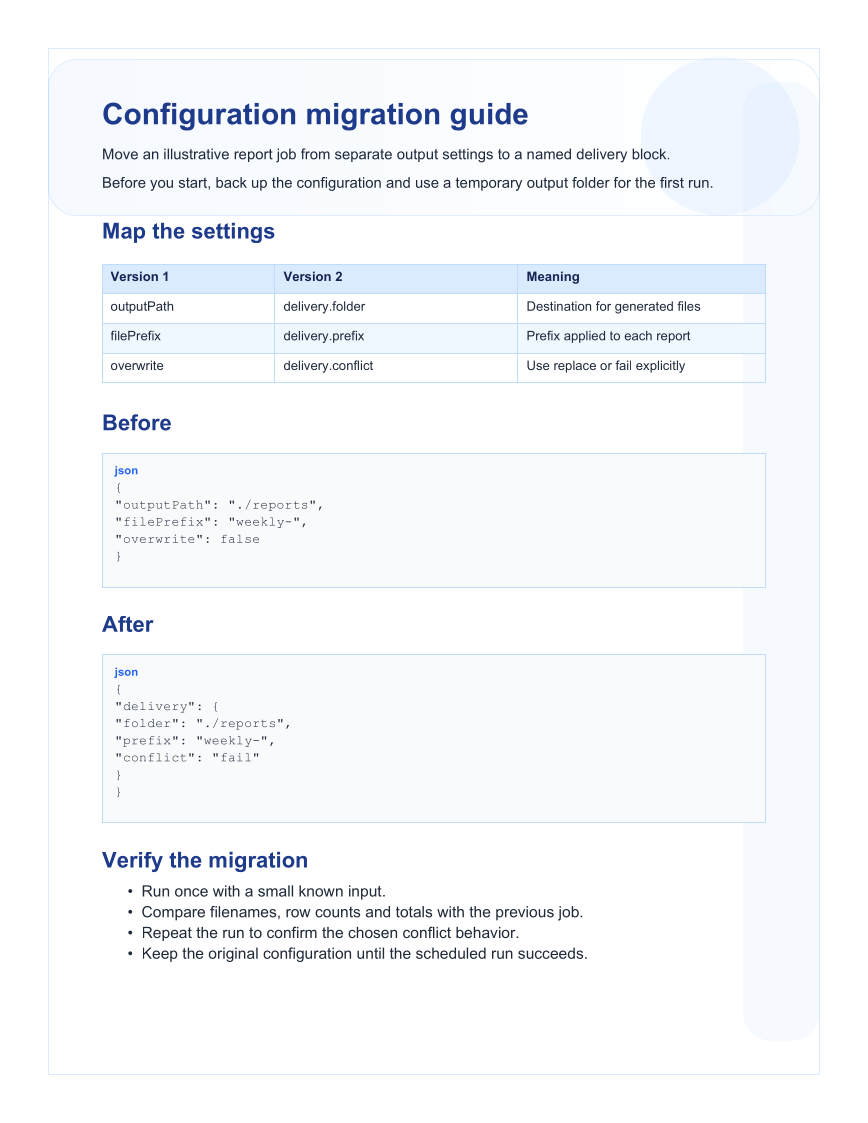
Use a table to connect old fields, new fields and their meaning.
Show complete examples
Put the before and after configurations in JSON code fences that readers can copy.
Define verification
Include small-input comparison, repeat-run behavior and a clear point at which the old configuration can be retired.
The C# source
This is the complete example file used to generate the download. The walkthrough runner creates the output directory and produces the additional previews.
using OfficeIMO.Markdown;

namespace OfficeIMO.Examples.Showcase.Workflows;

/// <summary>Produces a portable migration guide with explicit old-to-new mappings and a verification sequence.</summary>
internal static class MigrationGuide {
    internal static void Create(string folder) {
        var document = MarkdownDoc.Create()
            .H1("Configuration migration guide")
            .P("Move an illustrative report job from separate output settings to a named delivery block.")
            .P("Before you start, back up the configuration and use a temporary output folder for the first run.")
            .H2("Map the settings")
            .Table(table => table.Headers("Version 1", "Version 2", "Meaning")
                .Row("outputPath", "delivery.folder", "Destination for generated files")
                .Row("filePrefix", "delivery.prefix", "Prefix applied to each report")
                .Row("overwrite", "delivery.conflict", "Use replace or fail explicitly"))
            .H2("Before")
            .Code("json", "{\n  \"outputPath\": \"./reports\",\n  \"filePrefix\": \"weekly-\",\n  \"overwrite\": false\n}")
            .H2("After")
            .Code("json", "{\n  \"delivery\": {\n    \"folder\": \"./reports\",\n    \"prefix\": \"weekly-\",\n    \"conflict\": \"fail\"\n  }\n}")
            .H2("Verify the migration")
            .Ul(list => list.Item("Run once with a small known input.")
                .Item("Compare filenames, row counts and totals with the previous job.")
                .Item("Repeat the run to confirm the chosen conflict behavior.")
                .Item("Keep the original configuration until the scheduled run succeeds."));
        File.WriteAllText(Path.Combine(folder, "example.md"), document.ToMarkdown());
    }
}
Run it from the source checkout
Clone the OfficeIMO repository and run this command from its root with the .NET 10 SDK. The first run restores the example project's dependencies.
dotnet run --project OfficeIMO.Examples -f net10.0 -- --showcase-workflows --showcase-example markdown-migration-guideThe files are written to OfficeIMO.Examples/bin/Debug/net10.0/Documents/Workflows/markdown-migration-guide/. To use the example in your application, start with the Markdown guide and its package setup.
Downloads and scope
What the preview shows
The linked C# example generates this file. The Markdown source is reloaded and exported to PDF. Each PDF page is rendered for review.
What to keep in mind
The settings are a fictional application example, not OfficeIMO configuration. The PDF is a readable review copy of the Markdown.