Markdown · C# walkthrough
Release readiness checklist
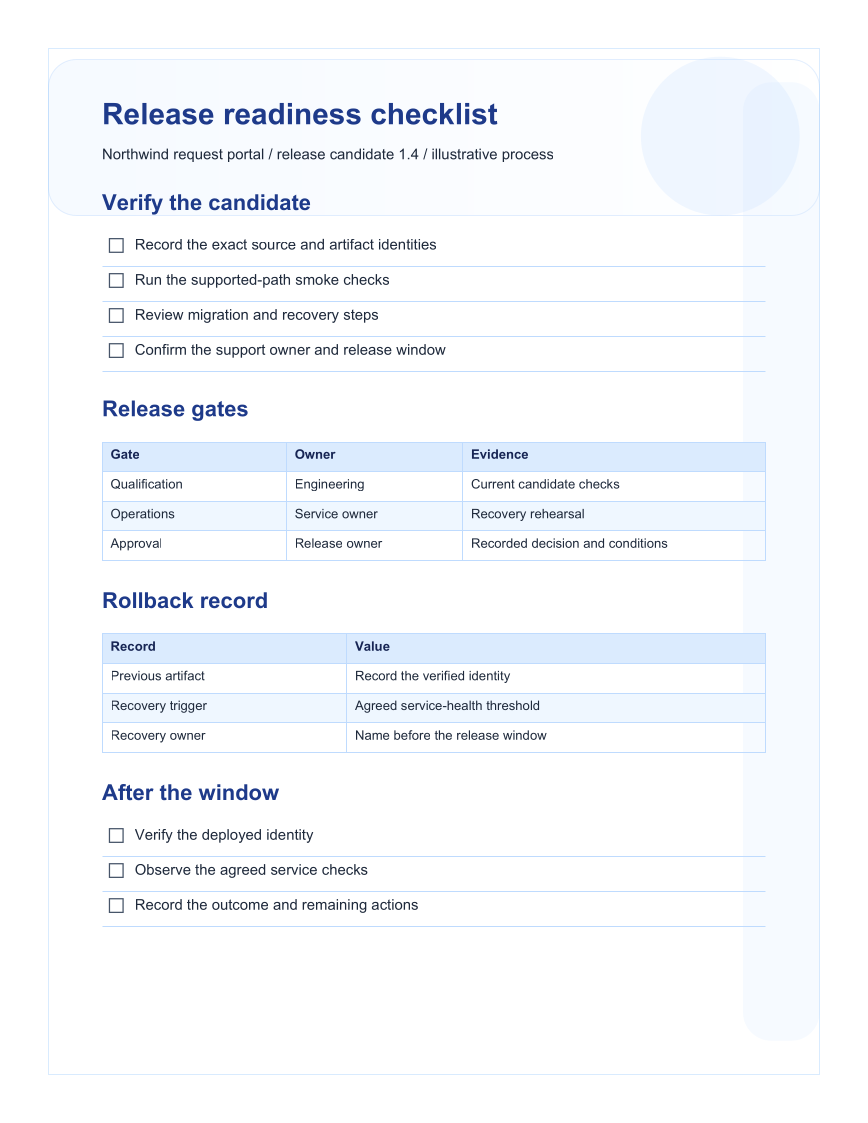
Keep qualification, approval and deployment verification visibly separate.
Opens the generated download in a local browser tool. The C# example below creates the document.
- Start with
- Readiness checks and release ownership
- Generate
- MD + PDF
How it works
Write observable checks
Use task items for candidate qualification.
Record evidence gates
Keep the owner and evidence for each decision.
Plan the recovery
Record rollback ownership and post-window verification.
The C# source
The example below shows the document API and layout used for this report. Follow the Markdown guide for package setup in your own project.
using OfficeIMO.Markdown;

namespace OfficeIMO.Examples.Showcase.Workflows {
    /// <summary>Creates a portable release-readiness checklist with explicit gates and a rollback record.</summary>
    internal static class ReleaseChecklist {
        internal static void Create(string folder) {
            var document = MarkdownDoc.Create()
                .H1("Release readiness checklist")
                .P("Northwind request portal / release candidate 1.4 / illustrative process")
                .H2("Verify the candidate")
                .Ul(list => list.ItemTask("Record the exact source and artifact identities")
                    .ItemTask("Run the supported-path smoke checks")
                    .ItemTask("Review migration and recovery steps")
                    .ItemTask("Confirm the support owner and release window"))
                .H2("Release gates")
                .Table(table => table.Headers("Gate", "Owner", "Evidence")
                    .Row("Qualification", "Engineering", "Current candidate checks")
                    .Row("Operations", "Service owner", "Recovery rehearsal")
                    .Row("Approval", "Release owner", "Recorded decision and conditions"))
                .H2("Rollback record")
                .Table(table => table.Headers("Record", "Value")
                    .Row("Previous artifact", "Record the verified identity")
                    .Row("Recovery trigger", "Agreed service-health threshold")
                    .Row("Recovery owner", "Name before the release window"))
                .H2("After the window")
                .Ul(list => list.ItemTask("Verify the deployed identity")
                    .ItemTask("Observe the agreed service checks")
                    .ItemTask("Record the outcome and remaining actions"));
            File.WriteAllText(Path.Combine(folder, "example.md"), document.ToMarkdown());
        }
    }
}
API used in this example
Use this in your project
Use your release process and exact artifact identities; this document performs no publishing or deployment.
The Markdown guide explains package setup and related document APIs.
Documents and scope
What the preview shows
The C# source generates the downloadable file. The runner reopens the editable document, validates Open XML where applicable and exports a PDF. Page previews come from the generated output.
What to keep in mind
Use your release process and exact artifact identities; this document performs no publishing or deployment.