RTF · C# walkthrough
Portable RTF support bulletin
Give a support team a compact document that can be edited in software accepting RTF and shared as a PDF review copy.
- Start with
- A support symptom, diagnostic steps and evidence fields
- Generate
- RTF + PDF
How it works
Format the headings
Apply font size, bold text, color and paragraph spacing through the native RTF paragraph and run APIs.
Write the diagnostic sequence
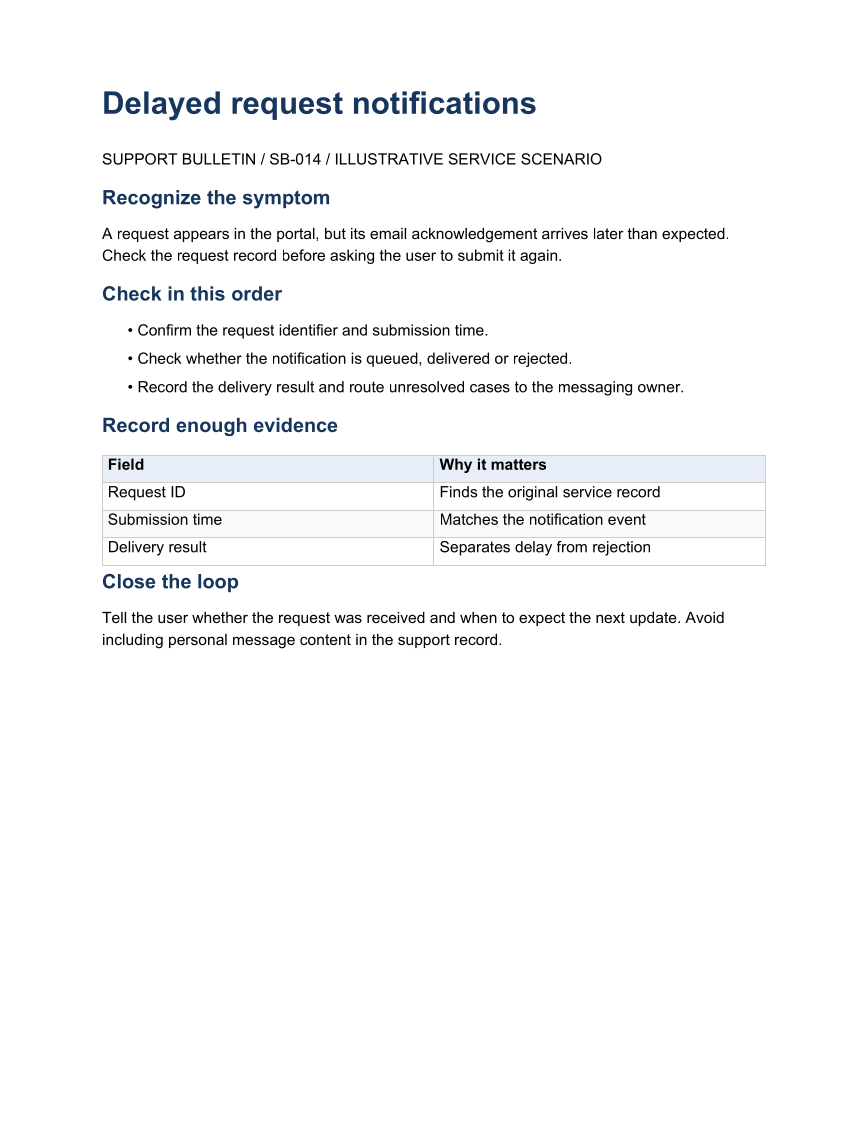
Add the symptom, an ordered sequence expressed as bullets and a table describing useful evidence.
Save and reopen the RTF
Serialize the document, then let the runner load the saved RTF and convert it to PDF.
The C# source
This is the complete example file used to generate the download. The walkthrough runner creates the output directory and produces the additional previews.
using OfficeIMO.Rtf;

namespace OfficeIMO.Examples.Showcase.Workflows;

/// <summary>Creates a compact RTF support bulletin with formatted headings and structured troubleshooting steps.</summary>
internal static class SupportBulletin {
    internal static void Create(string folder) {
        RtfDocument document = RtfDocument.Create();
        document.Info.Title = "Support bulletin: delayed request notifications";
        document.Info.Author = "OfficeIMO";
        int navy = document.AddColor(23, 54, 93), fill = document.AddColor(232, 238, 248);
        Heading("Delayed request notifications", 22);
        document.AddParagraph("SUPPORT BULLETIN / SB-014 / ILLUSTRATIVE SERVICE SCENARIO");
        Heading("Recognize the symptom");
        document.AddParagraph("A request appears in the portal, but its email acknowledgement arrives later than expected. Check the request record before asking the user to submit it again.");
        Heading("Check in this order");
        foreach (string step in new[] {
            "Confirm the request identifier and submission time.",
            "Check whether the notification is queued, delivered or rejected.",
            "Record the delivery result and route unresolved cases to the messaging owner."
        }) document.AddParagraph(step).SetList(kind: RtfListKind.Bullet).SetIndentation(leftTwips: 720, firstLineTwips: -360);
        Heading("Record enough evidence");
        var table = document.AddTable(4, 2); table.Rows[0].RepeatHeader = true; table.Rows[0].SetBackgroundColor(fill);
        string[,] rows = {
            { "Field", "Why it matters" },
            { "Request ID", "Finds the original service record" },
            { "Submission time", "Matches the notification event" },
            { "Delivery result", "Separates delay from rejection" }
        };
        for (int row = 0; row < 4; row++) for (int column = 0; column < 2; column++) table.Rows[row].Cells[column].AddParagraph(rows[row, column]);
        Heading("Close the loop");
        document.AddParagraph("Tell the user whether the request was received and when to expect the next update. Avoid including personal message content in the support record.");
        File.WriteAllText(Path.Combine(folder, "example.rtf"), document.ToRtf());

        void Heading(string text, double size = 14) {
            var paragraph = document.AddParagraph(text);
            paragraph.SpaceBeforeTwips = 160;
            paragraph.SpaceAfterTwips = 100;
            foreach (var run in paragraph.Runs) {
                run.FontSize = size;
                run.Bold = true;
                run.ForegroundColorIndex = navy;
            }
        }
    }
}
Run it from the source checkout
Clone the OfficeIMO repository and run this command from its root with the .NET 10 SDK. The first run restores the example project's dependencies.
dotnet run --project OfficeIMO.Examples -f net10.0 -- --showcase-workflows --showcase-example rtf-support-bulletinThe files are written to OfficeIMO.Examples/bin/Debug/net10.0/Documents/Workflows/rtf-support-bulletin/. To use the example in your application, start with the RTF guide and its package setup.
Downloads and scope
What the preview shows
The linked C# example generates this file. The runner reloads the saved RTF and exports it to PDF. Each PDF page is rendered for review.
What to keep in mind
The example is an illustrative support procedure. PDF conversion demonstrates the supported RTF content in this file, not every RTF feature.