Visio · C# walkthrough
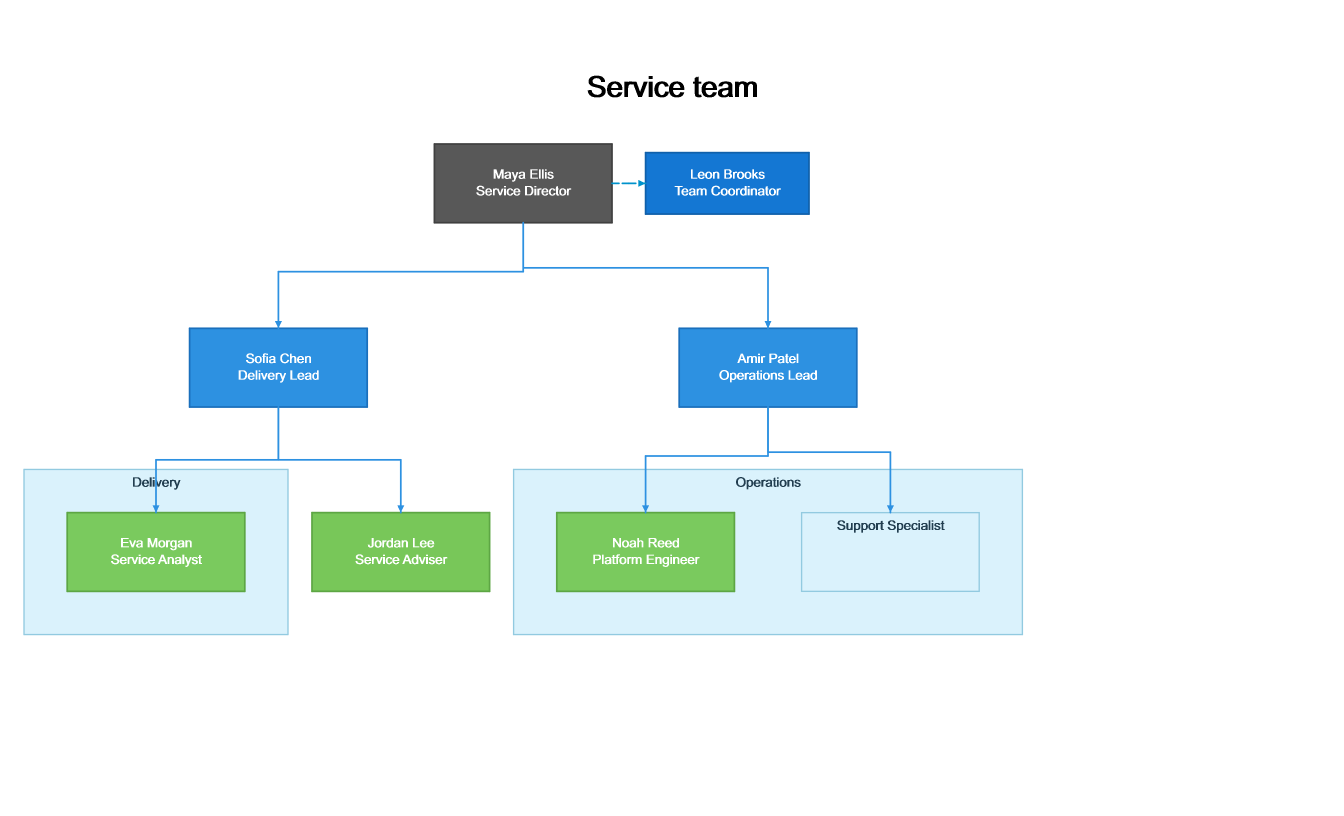
Organisation chart with team vacancies
Show both the reporting structure and the roles that still need an owner without drawing every box and connector by hand.
- Start with
- People, roles, reporting relationships and open positions
- Generate
- VSDX + SVG
How it works
Create the reporting hierarchy
Start with a root, add managers and attach positions using stable parent identifiers.
Add useful distinctions
Use Assistant, TeamBand, Vacancy and External to represent different relationships explicitly.
Validate and export
Save the VSDX, reopen it for validation and create PNG and SVG views through the native image export API.
The C# source
This is the complete example file used to generate the download. The walkthrough runner creates the output directory and produces the additional previews.
using OfficeIMO.Visio;
using OfficeIMO.Visio.Diagrams;

namespace OfficeIMO.Examples.Showcase.Workflows;

/// <summary>Builds an organisation chart with team bands, an assistant, a vacancy and an external adviser.</summary>
internal static class TeamOrganisation {
    internal static void Create(string folder) {
        var theme = VisioStyleTheme.Modern();
        theme.Container.TextStyle!.VerticalAlignment = VisioTextVerticalAlignment.Top;
        theme.Container.TextStyle.TopMargin = 0.08;
        var document = VisioDocument.Create(Path.Combine(folder, "example.vsdx"))
            .OrgChartDiagram("Service team", org => org
                .Theme(theme).Title("Service team").TeamBandPadding(0.45).Spacing(0.7, 1.1)
                .Root("director", "Maya Ellis", "Service Director")
                .Assistant("coordinator", "Leon Brooks", "Team Coordinator", "director")
                .Manager("delivery", "Sofia Chen", "Delivery Lead", "director")
                .Manager("operations", "Amir Patel", "Operations Lead", "director")
                .TeamBand("delivery-team", "Delivery", "delivery")
                .TeamBand("operations-team", "Operations", "operations")
                .Position("analyst", "Eva Morgan", "Service Analyst", "delivery", "delivery-team")
                .Position("engineer", "Noah Reed", "Platform Engineer", "operations", "operations-team")
                .Vacancy("support", "Support Specialist", "operations", "operations-team")
                .External("adviser", "Jordan Lee", "Service Adviser", "delivery"));
        document.Save();
    }
}
Run it from the source checkout
Clone the OfficeIMO repository and run this command from its root with the .NET 10 SDK. The first run restores the example project's dependencies.
dotnet run --project OfficeIMO.Examples -f net10.0 -- --showcase-workflows --showcase-example visio-team-organisationThe files are written to OfficeIMO.Examples/bin/Debug/net10.0/Documents/Workflows/visio-team-organisation/. To use the example in your application, start with the Visio guide and its package setup.
Downloads and scope
What the preview shows
The linked C# example generates this file. The runner reloads the VSDX, checks the authoring model and renders the saved diagram to PNG and SVG.
What to keep in mind
The names and structure are fictional. Image evidence comes from OfficeIMO's renderer and does not establish identical layout in desktop Visio.